Reviewing the Data for Listings in New York City the Team Noticed a Pattern the Listings Had Poor
Similar many paediatricians, Dani Dumitriu braced herself for the impact of the SARS-CoV-2 coronavirus when information technology outset surged in her wards. She was relieved when about newborn babies at her hospital who had been exposed to COVID-xix seemed to do just fine. Knowledge of the furnishings of Zika and other viruses that can cause nativity defects meant that doctors were looking out for problems.
But hints of a more subtle and insidious trend followed close behind. Dumitriu and her squad at the NewYork–Presbyterian Morgan Stanley Children's Hospital in New York Urban center had more than two years of information on infant evolution — since belatedly 2017, they had been analysing the communication and motor skills of babies upwards to half dozen months old. Dumitriu idea it would be interesting to compare the results from babies born earlier and during the pandemic. She asked her colleague Morgan Firestein, a postdoctoral researcher at Columbia University in New York City, to assess whether there were neurodevelopmental differences between the 2 groups.
A few days subsequently, Firestein chosen Dumitriu in a panic. "She was similar, 'We're in a crisis, I don't know what to practice, considering we not only accept an effect of a pandemic, just it's a significant 1,'" Dumitriu recalled. She was up most of that night, poring over the data. The infants born during the pandemic scored lower, on average, on tests of gross motor, fine motor and communication skills compared with those born earlier it (both groups were assessed by their parents using an established questionnaire)1. Information technology didn't affair whether their nativity parent had been infected with the virus or not; at that place seemed to be something about the environment of the pandemic itself.
Dumitriu was stunned. "We were like, oh, my God," she recalled. "We're talking about hundreds of millions of babies."
Although children have generally fared well when infected with SARS-CoV-ii, preliminary research suggests that pandemic-related stress during pregnancy could be negatively affecting fetal encephalon development in some children. Moreover, frazzled parents and carers might be interacting differently or less with their young children in means that could affect a child'south physical and mental abilities.
Lockdowns — which take been crucial for controlling the spread of the coronavirus — have isolated many young families, robbing them of playtime and social interactions. Stressed out and stretched sparse, many carers likewise haven't been able to provide the 1-to-in one case that babies and toddlers need.
"Anybody wants to document how this is impacting child evolution, and parent–kid relationships and peer relationships," says James Griffin, chief of the Kid Development and Beliefs Branch at the Eunice Kennedy Shriver National Institute of Kid Health and Homo Development in Bethesda, Maryland. "Anybody has concerns."
Some of the teams looking into these issues around the world are starting to publish their findings. New studies have begun. Firm answers are hard to come past, not to the lowest degree considering many child-development research laboratories shut downward during the pandemic.
Some babies built-in during the past two years might be experiencing developmental delays, whereas others might have thrived, if carers were at home for extended periods and there were more opportunities for siblings to interact. As with many aspects of wellness during the pandemic, social and economic disparities have a clear office in who is affected the most. Early on data suggest that the use of masks has non negatively affected children's emotional development. But prenatal stress might contribute to some changes in encephalon connectivity. The motion picture is evolving and many studies have not yet been peer reviewed.
Some researchers propose that many of the children falling behind in development will be able to catch upwards without lasting effects. "I do not expect that we're going to observe that there's a generation that has been injured by this pandemic," says Moriah Thomason, a child and boyish psychologist at the New York University Grossman School of Medicine.
A precipitous drop in play
One lab that managed to stay open during the COVID-19 pandemic was Dark-brown Academy's Advanced Infant Imaging Lab in Providence, Rhode Island. In it, Sean Deoni, a medical biophysicist, and his colleagues use magnetic resonance imaging (MRI) and other techniques to study how environmental factors shape brain development in infants.
Although the pandemic changed how they conducted their research — fewer visitors and more than cleaning — they continued inviting babies to their lab, to track motor, visual and language skills as part of a vii-year National Institutes of Wellness written report on early on childhood evolution and its effects on later wellness.
Withal, as the pandemic progressed, Deoni began hearing worrying comments from his colleagues. "What our staff began to tell me, anecdotally, was 'Man, it's taking these kids a lot longer to get through these assessments,'" Deoni recalled.
He was mystified, so asked his researchers to plot and compare the yearly averages and variances from the infants' neurodevelopmental scores. That's when they discovered that the scores during the pandemic were much worse than those from previous years (run into 'Development dip'). "Things just began sort of falling off a rock the tail end of last year and the outset part of this year," he said in late 2021. When they compared results across participants, the pandemic-born babies scored almost two standard deviations lower than those born before information technology on a suite of tests that mensurate development in a similar mode to IQ tests. They also found that babies from depression-income families experienced the largest drops, that boys were more affected than girlstwo and that gross motor skills were affected the nearly.
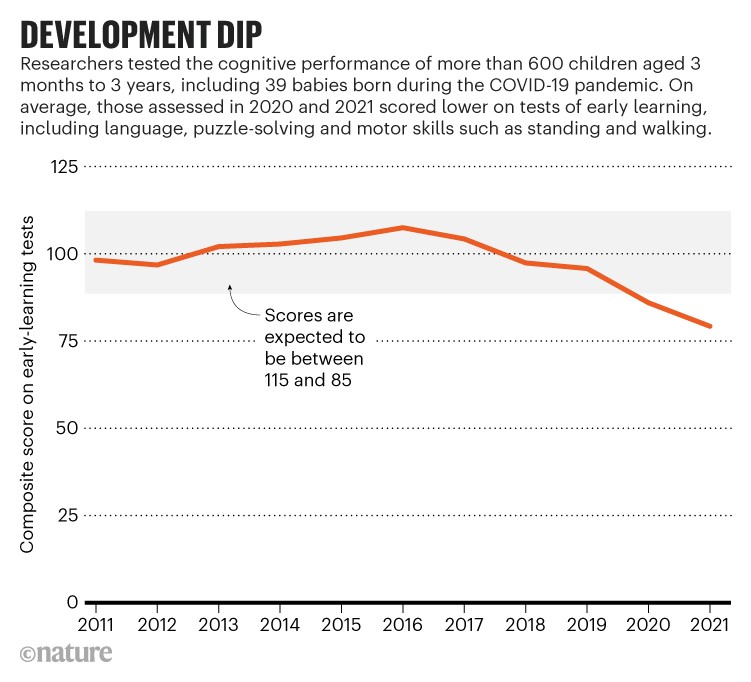
Source: Ref. 2
At first, Deoni causeless that selection bias was at play: perhaps the families who made the effort to come up in for testing during the pandemic were those whose children were at risk of developmental problems or were already showing them. Just, over time, he grew convinced that selection bias wasn't explaining the findings, because the children coming in did not take different backgrounds, birth outcomes or socio-economic statuses compared with previous participants.
These effects appeared drastic, just some researchers debate that they are not necessarily predictive of long-term problems. "IQ, equally babies, doesn't predict much," says Marion van den Heuvel, a developmental neuropsychologist at Tilburg Academy in kingdom of the netherlands. "It's really difficult to say anything almost what that will mean for their future." She points to a study3 showing that Romanian girls who started life in orphanages only were so adopted past foster families before 2.5 years of age were less likely to have psychiatric problems at 4.five years of age than were girls who remained in institutional care. That situation is dissimilar from a pandemic, but suggests that babies could make up for hardship once restrictions are lifted.
Worryingly, however, Deoni has found that the longer the pandemic has continued, the more deficits children have accumulated. "The magnitude is massive — it'south just astonishing," Deoni says of the findings, which are now under revision in JAMA Pediatrics.
When Deoni beginning posted his results on a preprint server2, in that location was a flurry of worrying media coverage — and backlash from the enquiry customs. There was "a real concern about the fact that these results were being put out without proper peer review," Griffin says.
Simply, assuming the findings exercise have merit, why might babies born during the COVID-xix pandemic exist experiencing significant cerebral — and especially motor — deficits? Deoni suspects that the bug stem from a lack of human-to-human interactions. In follow-up research that has non yet been published, he and his team have recorded parent—kid interactions at dwelling, finding that the number of words spoken past parents to their children, and vice versa, in the past two years has been lower than in previous years. He as well suspects that babies and toddlers are non getting every bit much gross motor exercise equally usual considering they aren't regularly playing with other children or going to playgrounds. "And the unfortunate thing is that those skills kind of lay the foundation for all the other skills," he says.
Other recent research supports the idea that lack of peer interactions could be holding some kids back. In a study published earlier this year, researchers in the Britain surveyed 189 parents of children betwixt the ages of eight months and 3 years, asking whether their children received daycare or attended preschool during the pandemic, and assessing language and executive performance skills. The authors found that the children'due south skills were stronger if they had received group care during the pandemic, and that these benefits were more pronounced among children from lower-income backgrounds4.
Those well-nigh at chance seem to exist children of colour or those from low-income families. For instance, a growing trunk of research suggests that amid school-aged children, remote learning might be widening the already-large learning and development gaps between children from affluent and depression-income backgrounds and between white kids and children of color. In the Netherlands, researchers found that kids did worse on national assessments in 2020 — compared with the three previous years — and that learning losses were up to 60% larger for children from less-educated familiesv.
In parts of sub-Saharan Africa — including Ethiopia, Kenya, Liberia, Tanzania and Republic of uganda — research suggests that some children have lost as much as a full year of learningsix. And in the United States, later the first lockdown, a report by the consultancy house McKinsey suggested that students of colour began school in autumn three to five months backside in learning, whereas white students were only i to three months behind (get.nature.com/3fauntp).
Masked effects
Children who have attended school or other grouping settings during the pandemic have typically been interacting with others who wore face masks. One important question is whether masks, which obscure parts of the confront of import for expressing emotions and speech, might also be affecting kids' emotional and linguistic communication development.
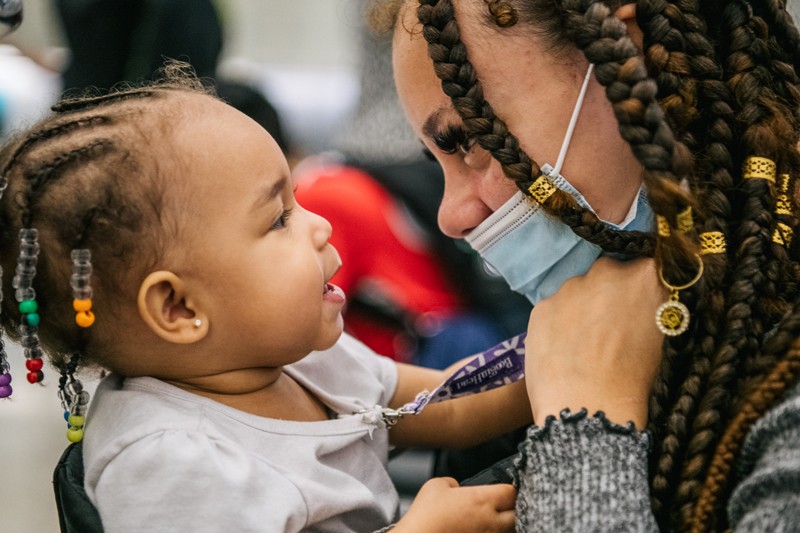
A mother with mask interacts with her girl while waiting for her PCR results in Houston, Texas. Credit: Brandon Bell/Getty
Edward Tronick, a psychologist at the University of Massachusetts Boston, has been bombarded with e-mails from parents and paediatricians concerned near the potential developmental effects of masking. Tronick is famous for his 1975 'Withal Face' experiment, which showed that when nascency parents suddenly remained straight-faced when interacting with their infants, their kids at starting time tried to become their attention, and then slowly withdrew and grew increasingly upset and wary7.
Tronick decided to see whether masks had a similar consequence. With his colleague, psychologist Nancy Snidman, he conducted an experiment (which has not yet been peer reviewed) in which parents used smartphones to record interactions with their babies before, during and after they put on face masks. Although babies noticed when their parents put on masks — they would briefly change their facial expression, wait away or point at the mask — they would so continue interacting with their parents as they had beforeviii. The mask is blocking only one aqueduct of communication, Tronick says. "The parent wearing a mask is still proverb, 'I'm interacting with y'all, I'yard all the same here for you, I'yard all the same connecting to you lot.'"
Face masks don't seem to interfere all that much with emotional or language perception, either. A study published in May reported that two-year-olds were notwithstanding able to empathize words spoken by adults in opaque confront masksix. Children "compensate for information deficits more readily than we think", says study pb author Leher Singh, a psychologist at the National University of Singapore. Researchers in the Us institute that, although face masks made it harder for school-age children to perceive adults' emotions — about as difficult every bit when adults were wearing sunglasses — the kids were notwithstanding, for the well-nigh part, able to make accurate inferencesx.
"In that location's a lot of other cues that kids tin use to parse apart how other people are feeling, like vocal expressions, body expressions, context," says study author Ashley Ruba, a postdoctoral fellow at the University of Wisconsin–Madison.
Pregnant and stressed
Other researchers are keen to know whether the pandemic could exist affecting children's development earlier they are born. Catherine Lebel, a psychologist who runs the Developmental Neuroimaging Lab at the Academy of Calgary in Canada, and her colleagues surveyed more than than 8,000 pregnant people during the pandemic. About one-half reported experiencing symptoms of anxiety, while one-third had symptoms of depression — a much higher percentage than in pre-pandemic years. How was this stress affecting babies in the womb?
To detect out, the researchers used MRI imaging to browse the brains of 75 of the babies 3 months later on nascence. In a preprint posted in October, they found that babies born to people who reported more than prenatal distress — more feet or low symptoms — showed dissimilar structural connections between their amygdala, a brain region involved in emotional processing, and their prefrontal cortex, an area responsible for executive functioning skills11.
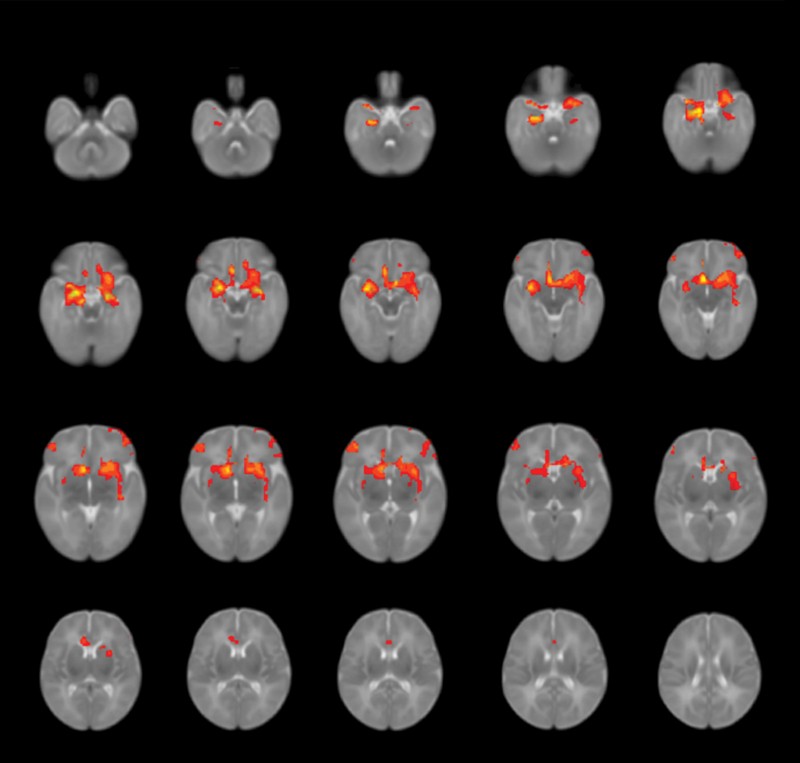
Brain scans showing average connectivity patterns between the amygdala and other regions in infants. Pandemic-related stress during pregnancy weakened connections in some babies. Credit: Kathryn Manning
In a previous, small study, Lebel and her team had made the link between prenatal depression and brain connectivity differences in those same areas, and had suggested that in boys, these brain changes correlated with aggressive and hyperactive behaviour at preschool age12. Other teams have plant that changes in connectivity between these areas in adults are risk factors for depression and anxietythirteen. "Those are the areas that are involved in emotion processing, and lots of unlike behaviours," Lebel says.
Other research has found like associations between prenatal pandemic stress and kid evolution. Livio Provenzi, a psychologist at the IRCCS Mondino Foundation in Pavia, Italy, and his colleagues observed that three-calendar month-erstwhile babies of people who reported experiencing more stress and feet during pregnancy had more than problems regulating their emotions and attention — they were less able to maintain their attention on social stimuli, for instance, and were less easily soothed — than were babies of people who were less stressed and anxious during pregnancyxiv.
Thomason is running her own study to assess the effects of maternal stressors on children's brains and behaviour. She notes that, although there is a lot of concern nearly how prenatal stress might touch on pandemic babies, early on findings such as these practise not mean that children are going to struggle for the rest of their lives. "Children are so adaptive, and elastic. And nosotros practice expect that things are going to amend and that they should exist able to exist resilient to a lot of what's happened," she says.
Indeed, enquiry on historical disasters suggests that, although stress in the womb can be harmful to babies, it doesn't always take lasting effects. Children born to people who experienced considerable stress as a consequence of the 2011 floods in Queensland, Australia, showed deficits in problem-solving and social skills at half-dozen months of age, compared with children born to people who experienced less stress15. Nevertheless, by 30 months, these outcomes were no longer correlated with stress, and the more responsive that parents were to their babies' and toddlers' needs after birth, the improve the toddlers didxvi.
Caution and action
The inquiry on pandemic babies presents a mixed picture show, and scientists say information technology'southward too early to describe meaningful interpretations. For one affair, some of these early, often unpublished findings might not reflect reality, says Catherine Monk, a medical psychologist who works with Dimitriu at NewYork–Presbyterian.
The parents who chose to participate in some early studies, for instance, might not exist a representative sample, Monk says. Perhaps they were already worried about their kids on the basis of the behaviours they are seeing. Furthermore, she says, the results of in-person studies such as Deoni'southward could be afflicted by the wearing of face masks — possibly not a lot, only enough to skew results.
As Thomason wrote terminal year in a commentary17 in JAMA Pediatrics, the incentive to publish interesting findings might also be shaping these early studies. "Scientists are quick to go look for a harmful difference. It's the thing that's going to become the attention of the media; it's the thing that's going to get published in a high-impact periodical," she says.
Researchers and funders are launching big studies and collaborations that could assist to build a clearer picture. The US National Institute on Drug Abuse is funding a scattering of studies through its Healthy Brain and Child Development Written report. These will look at how maternal stress and substance use during the pandemic affect child development. In improver, alliances and conferences take been formed to bring researchers together and share emerging information. In March 2020, Thomason launched the international COVID Generation Inquiry Alliance, which brings together researchers from xiv countries studying families with young children during the pandemic. The alliance, which held a research top in November 2021, includes researchers in North and South America, Europe, Australia, Asia, the Center Due east and Africa.
Even if kids' brains are truly being affected by the pandemic, at that place is all the same fourth dimension to steer them back on form, Dumitriu notes. "We can totally get alee of this condign a public-health emergency," she says. "The brains of six-month-olds are very plastic, and nosotros can get in there, and we can change their trajectory."
Parents tin can make headway past playing and talking with their young children regularly, and giving them opportunities to play with others in safe settings. Policy changes aimed at supporting families and children could brand a divergence, too. Lebel's researcheleven institute that meaningful social back up, such as from a partner or close friend, during pregnancy resulted in much less prenatal distress. "We could do so much more of that in the prenatal care ecosystem," says Monk. Researchers also argue for interventions that support families immediately after nativity. Provenzi's researchxiv has plant that people who had but given nascence and were visited at home by nurses and neonatologists experienced less stress and anxiety than those who did not receive these visits.
Overall, researchers maintain that virtually children will probably be OK — but more than usual might currently be struggling. And if we want to support those who are falling behind, we should ideally intervene shortly. "Kids are certainly very resilient," Deoni says. "Just at the same fourth dimension, we as well recognize the importance of the first 1,000 days of a kid'due south life equally existence the crucial early foundations." The first pandemic babies, built-in in March 2020 are, at this bespeak, more than 650 days old.
Children "are a product of their environment", Deoni says. "The more than that we can stimulate them and play with them and read to them and love them — that'due south what it's going to take."
Source: https://www.nature.com/articles/d41586-022-00027-4
0 Response to "Reviewing the Data for Listings in New York City the Team Noticed a Pattern the Listings Had Poor"
Post a Comment